Facebook's New Ad System
Eight chapters on what Meta changed on October 28, 2026: how Facebook and Instagram now pick which ad each person sees, what the experts say to do about it, and how to run insurance lead ads under the new rules. Each chapter has the notes, flashcards and a quiz, and most have videos and reading.
What Meta Changed On October 28, 2026
On October 28, 2026 Meta, the company behind Facebook and Instagram, announced three upgrades to the system that decides which ad each person sees. Ad buyers started calling it "Andromeda 2.0". This chapter is the big picture: what was announced, what each piece does, and why it matters for anyone paying for ads.
Watch
Dakota Hermes, Andromeda Was The Small UpdateInstagram reel, Nov 2, 2026, about 2 minutes
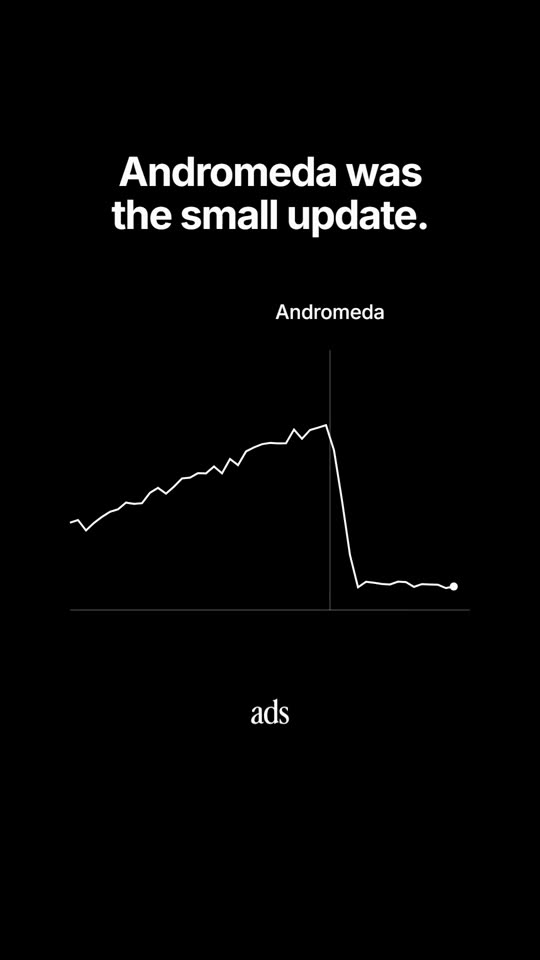 Watch On Instagram
Listen for: the old system scored groups of ads, the new one scores every ad; 50 versions of one idea is one shot, 5 different ideas is five.
Antonio Ventre, Meta Andromeda 2.0 Is Here, What Changes Now?YouTube, Oct 29, 2026, about 14 minutes
Listen for: the six changes he lists and what he tells his ecommerce clients to do.
Sam Piliero, Facebook Ads Is About To Change ForeverYouTube, Nov 1, 2026, about 10 minutes
Listen for: give Meta more truly different ads; add value to the offer instead of discounting.
Read
- Meta Engineering, Oct 28, 2026: the next generation of Meta Andromeda.
- Meta Engineering, Oct 19, 2026: GenRecs Tokenization.
- Meta for Business, Oct 28, 2026: Inside the Three New AI Innovations in Ads Ranking.
- AdExchanger, Oct 28, 2026: Meta has a new ad ranking system built on language models.
What To Know
- The announcement was October 28, 2026. Three upgrades, all already switched on. Nobody has to change a setting to get them.
- Upgrade 1, the new Andromeda. Andromeda is the step that makes the shortlist of ads for each person. It now gives every eligible ad a real score, at over 1 billion ads per second on each server. Meta says that is about 100 times the 2024 system while using about 300 times less computing.
- Upgrade 2, a bigger GEM. GEM is Meta's biggest ad model. It is too big to pick ads live, so it trains the smaller models that do. The new GEM reads a 2 times longer history of what each person engaged with. Meta credits GEM with up to 18.9% more conversions since 2025.
- Upgrade 3, GenRecs (new). AI reads each ad's pictures and words and turns them into a short code of shared "tokens". Similar ads get similar codes. A brand-new ad can then borrow what Meta already knows about ads like it, instead of starting from zero.
- "Andromeda 2.0" is a nickname from ad buyers. Meta calls it "the next generation of Meta Andromeda".
- Meta's own results for these upgrades are small but real: Andromeda +2.4% Facebook conversions since 2025; the new suggestion model about +2% on the Facebook feed. Facebook ranking improvements gave +8.3% clicks and +15.7% conversions in the spring 2026 quarter.
- Ads got pricier. In the summer 2026 quarter, the average price per ad was up 14% and the number of ads shown up 10%.
- None of this replaces the 2024 to 2025 basics. Andromeda (December 2024), GEM (2025), Advantage+ as the default setup, and "the ad is the targeting" were already here. October 2026 made them stronger.
Words To Know
- Andromeda
- the shortlist step. It picks the few thousand ads worth considering for one person out of tens of millions.
- GEM
- Meta's biggest ad model. It trains the models that pick ads live.
- GenRecs
- short for generative recommendations. It describes ads as tokens and predicts the next ad a person will want.
- Token
- a short code that describes part of an ad: the product, the setting, the style, the message.
- Conversion
- the action you paid for: a lead form sent, a call, a sale.
- Advantage+
- Meta's automatic campaign setup, where Meta picks the audience, placements and budget split.
Don't Mix These Up
- Andromeda vs GEM. Andromeda makes the shortlist. GEM teaches the models that rank the shortlist. Different steps.
- "Andromeda 2.0" vs Meta's name. Same thing. One is the nickname, one is the official name.
- Big claims vs measured lift. "A billion ads a second" is speed. The result for advertisers is a few percent more conversions, by Meta's own count.
How An Ad Gets From Your Account To Someone's Screen
Every time someone scrolls Facebook or Instagram, Meta runs a contest in a fraction of a second to pick which ad goes in the next slot. Meta laid out the steps in plain English on October 28, 2026. Knowing the steps tells you which parts you control.
Read
- Meta for Business, Oct 28, 2026: How Meta's Ads System Matches Your Ad to the Right Person at the Right Time.
- Ben Heath's video, The Truth About Meta's Andromeda Update (Nov 11, 2025), walks through the same steps from the 2024 post.
What To Know
- Who is allowed to see it. Your hard rules decide which ads can even be considered for a person: location, minimum age, exclusions, and the limits of a special ad category. This now runs on the same machine as the scoring.
- The shortlist (Andromeda). Out of tens of millions of ads, it picks the few thousand worth ranking for this person, in milliseconds. New in 2026: every eligible ad gets scored first, using many interests per person and the order of the ads they engaged with. The new suggestion model adds ads it predicts this person will want.
- The ranking. Models trained by GEM predict how likely this person is to take your action. "Sequence learning" reads the order of a person's actions to guess what they want next. One shared system (Meta calls it Lattice) learns across all goals and apps.
- The auction. The ads left compete on three things: your bid (your budget and goal turned into a bid), the estimated action rate (Meta's guess this person will do what you want), and ad quality (the whole experience, from the ad through what happens after the click).
- Meta's own line: a more relevant ad with a better customer experience can beat a higher bid. Money alone does not win.
- Quality signals Meta names: what people do when they see the ad (watch, click, hide it), low-quality traits like engagement bait or holding back key information, and over 200 million customer surveys a year asking things like whether people felt misled.
- The steps you control: the ad itself (it decides who it gets matched to), your bid and budget, the quality of what happens after the click, and the data you send back.
- The steps you no longer really control: who exactly sees it. Your audience choices are mostly suggestions now. Location and minimum age still hold firm.
Words To Know
- Retrieval
- the shortlist step. Same as Andromeda's job.
- Ranking
- scoring the shortlist by how likely each person is to act.
- Auction
- the final contest for the ad slot.
- Estimated action rate
- Meta's prediction that this person will take your action.
- Ad quality
- how people feel about your ad and what happens after they click.
- Sequence learning
- reading the order of what a person did to predict what comes next.
Don't Mix These Up
- Highest bid vs winning ad. The winner has the best mix of bid, predicted action and quality. A cheaper, better ad can beat a bigger bid.
- Shortlist vs auction. An ad has to make the shortlist before it ever enters the auction. Two separate cuts.
Old Andromeda vs New: From Scoring Groups To Scoring Every Ad
This is the heart of Dakota Hermes's reel. In 2024 Meta had more ads than it could check one by one, so it took a shortcut. In 2026 the shortcut is gone. This chapter explains both, and what the change means for ads that look alike.
Watch
Dakota Hermes, Andromeda Was The Small Updatefirst minute
Watch On InstagramListen for: 2024 scored only the best-looking groups; 2026 scores every eligible ad.
Antonio Ventre, Meta Andromeda 2.0 Is Herestarts at 1:02, about 2 minutes
Listen for: an ad that missed the old shortlist never reached the auction.
What To Know
- 2024: too many ads. Andromeda launched in December 2024. Meta sorted ads into a layered index, like a family tree, and only explored the branches that looked best. Many ads never got their own score.
- Advantage+ was already picking the audience. So the ad itself decided which branch it landed in. That is the real meaning of "the creative is the targeting".
- That is why 50 versions of one ad most likely landed on the same branch and fought each other for the same people.
- 2026: every eligible ad gets scored. Meta's words: the system "scores every eligible ad in the candidate pool". Nothing gets skipped at that step. A good ad can't get buried on a weak branch, and a weak ad can't hide on a strong one.
- "The groups are gone" is the reel's reading, not Meta's words. It is a fair reading of the shortcut being replaced. But it has nothing to do with ad sets in Ads Manager, which are still there.
- Look-alike ads are still treated as alike. GenRecs gives similar ads similar tokens. Fifty near-copies still look like one idea to the system.
- The shortlist still exists. Tens of millions of ads still get cut to a few thousand per person. What changed is that every eligible ad gets a real score before the cut.
- It reads the order. Meta for Business: sequence learning "reads the order of a person's actions". So the system can tell which of your ads someone already responded to, and in what order.
- Better early matching. The shortlist step is now nearly as smart as the final ranking. A new ad can be judged partly by what it shows and says, before you spend much on it. Antonio Ventre expects budget to spread more fairly: ads that get spend are more likely real winners, and ads that get none are more likely real losers.
- Many interests per person. Meta replaced one picture of each person with several, to capture interests that change over time and by situation. One person can care about saving money, trusting the agent and getting it done fast, all at once.
Words To Know
- Candidate pool
- every ad that is allowed to be shown to this person.
- Eligible ad
- an ad that passes the hard rules (location, age, category limits).
- Layered index
- the 2024 tree that grouped ads so Meta only had to look at the best branches.
- Early matching
- judging a new ad from its content before it has much spending history.
Don't Mix These Up
- Groups of ads inside Meta's system vs ad sets in your account. The reel's "groups" are Meta's internal shortcut. Your ad sets are a setting you control. The update did not remove ad sets.
- Every ad scored vs every ad shown. Every eligible ad gets a score. Only the best few thousand per person move on, and only one wins each slot.
How Meta Reads Your Ad: The Ad Is The Targeting
If Meta no longer lets you choose exactly who sees an ad, how does it decide? It reads the ad. The pictures, the people on screen, the setting and the words all tell the system who the ad is for. This chapter explains how, and why look-alike ads compete with each other.
Read
- Meta Engineering, Oct 19, 2026: GenRecs Tokenization.
- Jon Loomer, Andromeda course lessons (Jan to Mar 2026).
- Marketing Brew, Sep 28, 2026: Meta tells agencies near-identical ads won't rank as highly.
What To Know
- AI looks at each ad's pictures, video and words and turns them into a short string of tokens: the product, the colour, the style, the message, the kind of person on screen.
- Meta's own comparison: similar ads share tokens "much as related words share roots".
- That description is a big part of who the ad gets matched to. An ad that clearly looks and sounds like it is for a certain kind of person gets matched to people like that.
- Ads that look and say the same thing get the same tokens, so they get matched to the same people and compete with each other. That is why near-copies don't buy you more reach.
- Truly different ads reach different groups of people. More genuinely different ads means more kinds of people reached.
- A new ad borrows what Meta already knows about ads with similar tokens. Meta says this puts new ads "on a faster track". The learning period still exists, it is just shorter.
- Meta's vice president of ads infrastructure, Matt Steiner: "the importance of targeting is diminishing over time."
- Meta's own advice to advertisers: the focus has moved from narrow targeting to variety in the ads themselves.
- Creative diversity rating. Ads Manager now shows Low, Medium or High per ad set, based on how alike the images and video thumbnails look. Meta labels it "estimated" and still being built. First seen August 26, 2026.
- Meta told agencies that ads with the same look and the same opening line won't rank as highly. Meta would not say exactly how it measures "alike".
- What counts as truly different: change at least one big thing. The angle (fear, savings, a story, proof), the person on screen, the format (talking to camera, a still picture, a slideshow, a testimonial, a screen recording), or the setting. Changing only the headline, the colour or the text on top usually does not count.
Words To Know
- Creative
- the ad itself: picture or video, words, headline.
- Creative diversity
- how different your ads are from each other.
- Angle
- the reason the ad gives someone to care: save money, avoid a mistake, trust a person, get it done fast.
- Format
- the shape of the ad: video, still picture, slideshow, testimonial.
- Hook
- the first line or first seconds that make someone stop scrolling.
Don't Mix These Up
- A new ad vs a new idea. A new headline on the same picture is a new ad but the same idea. To Meta it looks like the same thing.
- Creative diversity rating vs results. The rating measures how different your pictures look. It does not measure whether the ads work.
Different Ideas, Not More Copies
This is what the reel and the videos tell you to do with your ads. The short version: find the wording that works for each idea with small tests, then run a handful of truly different winners together and let Meta match them to people.
Watch
Dakota Hermes, Andromeda Was The Small Updatesecond half, from 1:05
Watch On InstagramListen for: test variations to find each winner, then run your five most different winners together.
Antonio Ventre, Meta Andromeda 2.0 Is Herestarts at 3:01, about 7 minutes
Listen for: motivation, situation and objection; one ad set per type of customer.
What To Know
- 50 versions of one idea is one shot. 5 different ideas is five shots. (Dakota Hermes)
- If someone already scrolled past your idea, a new opening line on the same idea gets the same answer. A different angle is a new reason to stop.
- Still test small changes, for a different job. In one of Dakota's accounts, ads identical except for one line of text got wildly different results. Small changes tell you which message works, because the message is the only thing that changed. Different ideas are how you grow.
- The method: test variations to find each idea's winner. Then put your 5 most different winners together and let Meta match them to people.
- Build ads around reasons to buy (Antonio Ventre). For each angle, write down:
- Motivation — why they want it (example: peace of mind, keeping their doctor).
- Situation — when the problem shows up (example: a letter from their plan saying benefits are changing).
- Objection — what makes them hold back (example: "Will this cost me more?", "I've been burned before").
- Each ad should answer one real customer question and show the proof for it.
- Five questions for every ad before it runs: What will we learn from it? Who is it for? What situation or problem does it address? What reason to buy does it add? What proof backs it up?
- Match the format to the angle. A "this really works" angle needs a testimonial. A "how it works" angle needs a simple walk-through.
- One person, several angles, in order. Meta now shows different angles to the same person over time. So you want a mix of attention-getting ads and ads that ask for the action, and you let Meta order them.
- Grab attention and ask for the action in the same ad. An ad that only grabs attention, or only pushes the offer, won't be treated as a winner (Antonio Ventre).
- Before you call an idea a failure, ask whether you showed it in the right format and wording. The same idea filmed somewhere else, or with a different opening, can do very differently.
How Many Ads (the experts disagree)
- Meta gives no official number. The old "at most 6 ads per ad set" advice is gone.
- Jon Loomer: typical ad sets run 4 to 5. He tested 20, 30 and 50 in one ad set and found it worked against him.
- AdScale (1,200+ online stores): above 7 live ads, clicks flatten and costs rise 8 to 12%. Aim for 4 to 6 truly different ideas.
- Ben Heath: 20 or more good ads per ad set is normal for bigger budgets.
- Jared Robinson: hundreds a month (this also sells his agency's service).
- Professor Charley T: the opposite. Start with 5 ideas and don't keep piling on new ads.
- Plain guide for a small budget: 4 to 6 truly different ads in one ad set. Add 2 to 3 new ideas every 2 to 3 weeks.
Words To Know
- Variation
- the same ad with one small thing changed, used to learn which message works.
- Concept
- a whole idea for an ad: an angle, a format and a message together.
- Motivation, situation, objection
- why they want it, when the need shows up, what makes them hesitate.
Don't Mix These Up
- Testing variations vs scaling ideas. Variations find the best wording for one idea. Different ideas are what reach more people.
- More ads vs more different ads. Meta's own 2024 paper said more variety drives better results. Not more ads, more different ads.
Setting Up Campaigns Under The New System
The structure of your account matters less than it used to, but the wrong structure still hurts. This chapter covers how to set up, test and keep ads fresh, what Meta changed in Ads Manager in 2026, and what to stop doing.
Read
- Jon Loomer, podcast on removing placement controls (Sep 9, 2026).
- Confect study of 3,014 advertisers (Mar 10, 2026).
- AdsUploader, Meta Ads updates, October 2026.
What To Know
- Fewer campaigns, fewer ad sets, more different ads in each. One main campaign per goal, 1 to 3 ad sets, a broad audience, automatic placements and budget.
- One ad set per type of customer, not one per angle (Antonio Ventre). Put several angles inside each ad set so Meta can learn the order to show them in.
- Meta's guide: aim for about 50 results per ad set per week so the system can learn. A small account may never reach that, which is another reason to keep ad sets few.
- Test new ideas in a small separate ad set. Give each a few days and enough spend, then move the winners into the main ad set. Don't judge on day one.
- Refresh more often. Ads now wear out in about 2 to 4 weeks instead of 6 to 8 (Confect). One study of $130 million in spend found winning ads lasted about 36 days.
- Use the right sizes. Tall 9:16 for Reels and Stories, with videos around 15 seconds, plus 4:5 or square.
- Send better data back. Tell Meta which leads became appointments or sales (Meta's Conversions API, and the "Conversion Leads" goal). Then Meta looks for people who buy, not people who just fill in forms. Meta quoted about 21% lower cost per good lead in a 2025 test of 1,031 advertisers.
What Changed In Ads Manager In 2026
- Placement exclusions going away for Sales and Leads ad sets (spotted August 2026). Replacements: a different ad per placement, placement value rules that lower your bid on a placement, and account-wide exclusions. Rollout is uneven.
- Creative diversity rating per ad set (August 2026).
- Results broken down by each picture or video (October 27, 2026).
- Customer Lifecycle Strategy opened to everyone (October 6, 2026): keep existing customers out of new-customer campaigns.
- Coming by end of 2026: describe your ideal customer in plain words and Meta finds the audience.
- On-device conversion measuring switches on by default around November 12, 2026. Reported results may rise because of how they are counted, not because more people bought.
- Since March 2026, a "click" result counts link clicks only. Engaged views are counted separately.
- Meta's AI Business Assistant: advertisers who used its suggestions saw almost 5% more conversions at the same cost. It is starting to test making changes for you, with your approval.
Stop Doing
- Stacking narrow interests to build an audience.
- Splitting money into many small ad sets.
- Running 20 near-identical versions of one ad.
- Switching off placements by guesswork.
- Judging an ad after a few hours.
- Turning ads on and off over and over. Each time it can restart the learning.
Words To Know
- Ad set
- the level that holds the budget, audience and placements for a group of ads.
- Placement
- where the ad shows: Facebook feed, Instagram Reels, Stories and so on.
- Learning phase
- the first stretch after launch when Meta is still figuring out who to show an ad to.
- Conversions API
- a direct line from your own system to Meta that reports what happened after the lead.
- Ad fatigue
- when people have seen an ad so often it stops working.
Don't Mix These Up
- Testing ad set vs main ad set. Testing finds new winners on a small budget. The main ad set is where proven winners get most of the money.
- More reported results vs more real results. The November 12 counting change can make numbers jump without more real customers.
Facts, Rumors And Sales Pitches
Every big change brings a wave of experts selling courses. Some of what is going around is Meta's own words, some is a fair reading, and some is made up. This chapter sorts them.
What To Know
- Confirmed by Meta: every eligible ad is scored; over 1 billion ads a second per server; the system reads the order of a person's actions; many interests per person; similar ads share tokens; better early matching; a creative diversity rating that Meta calls "estimated".
- A fair reading, not Meta's words: "the groups are gone". The 2024 shortcut was replaced by scoring everything, but look-alike ads are still treated as alike.
- Overstated: "ads no longer miss the shortlist". The shortlist still cuts tens of millions down to a few thousand per person.
- Nickname: "Andromeda 2.0". Meta never uses it.
- Rumor: the "Entity ID" idea, that Meta lumps near-copies under one ID so 50 versions get "one ticket" to the auction, and that ads more than 60% alike get pushed down. Meta has never published either term or number. What Meta has said: similar ads share tokens.
- Rumor: a Meta "internal test" where one ad set with 25 different ads got 17% more conversions at 16% lower cost than five ad sets of five. Quoted by an agency; Meta's original was never found.
- Rumor: the limit of 250 live ads per page has been lifted. Seen in some accounts, not documented.
- Press report, not a product: fully automatic ads by the end of 2026. The Wall Street Journal reported it as Meta's goal. Only pieces exist so far.
- Unchecked numbers in the videos: Sam Piliero's "early white paper" figures could not be checked (the +8.3% and +15.7% match Meta's spring 2026 earnings call, not a secret paper). MAXAI's "56% of results come from the ad itself" is an old industry figure shown as new.
- How the video experts rank on trust: Ben Heath works straight from Meta's own posts. Sam Piliero has the newest information. Charley T has the most detailed plan but pitches his course about 6 times and cites "internal Meta documents" he can't show. Jared Robinson's "make far more ads" doubles as a pitch for his agency. MAXAI gives no sources.
- How to check a claim yourself: look for the exact words on engineering.fb.com or facebook.com/business. If an expert says "Meta told us" but shows no page, treat it as a rumor.
Words To Know
- Primary source
- the company's own words: its engineering blog, business news page or earnings call.
- Entity ID
- a term ad buyers made up for how Meta might group look-alike ads. Not Meta's term.
- Earnings call
- the quarterly call where Meta reports results to investors. Many of the real numbers come from here.
Don't Mix These Up
- What Meta said vs what an expert says Meta meant. Both can be useful. Only one is a fact.
- Similar ads share tokens (Meta) vs the 60% rule (rumor). The first is published. The second has no source.
Running Insurance Lead Ads Under The New System
Insurance ads play by stricter rules on Facebook. You can't pick ages, ZIP codes or look-alike audiences. That sounds like a handicap, but under the new system it matters less, because the ad itself is how Meta finds the right people. This chapter covers the rules and a simple setup for a small agency.
Read
- Meta for Developers, Special Ad Categories page.
- Elevarus, Final Expense Meta Ads, Jul 1, 2026.
- Media Logic, Meta's Healthcare Ad Changes, Aug 12, 2025.
What To Know
- Insurance falls under the Financial Products and Services category, required since January 2025 for US advertisers. That covers health, life, final expense and Medicare plans. You must declare it. Not declaring gets ads turned down or the account flagged.
- What you can't do: pick ages (it is locked to 18 to 65+, so you can't choose 64 and up), pick gender, use ZIP codes or neighborhoods, use a radius under 15 miles, exclude locations, use demographic or behavior targeting, exclude interests, use look-alike audiences, or use saved audiences. Interests come only from an approved list.
- What you can still do (Meta's own developer page): use your own customer lists to include or exclude people, and use Advantage+ audience. Check each list in Ads Manager.
- Using a customer list to sneak in age targeting breaks the rules.
- Why the 2026 changes help an insurance agency: you already can't target by age. So the ad itself is how Meta finds someone turning 65 or someone who needs final expense coverage. An ad that clearly looks and sounds like it is for that person gets matched to people like that. This is the allowed way to reach them now.
- But don't call out the viewer. "Turning 65?" aimed at the reader can break Meta's personal attributes rule. Talk about the topic, not the person: "What changes when you turn 65" rather than "You're turning 65".
- Health data limits (since January 2025). Meta can sort health insurers into a Health and Wellness group with three levels of limits. That can limit the results you send back, and switch off audiences or custom results whose names hint at a health condition. Check yours in Events Manager, under data source settings.
- Lead form rules. Meta's instant forms can't ask for health information, a Medicare number, a Social Security number, or financial details without permission. Keep the form to name, phone, email and maybe state, with clear consent wording above the submit button. Ask health and current-plan questions on the call.
- Send back what happened, safely. Report which leads became appointments or sales so Meta learns which kind of person buys. Use plain names like "Qualified" or "Appointment Set", never a health condition.
- Medicare marketing rules still apply on Facebook. Meta does not check them. No government logos, no implying you are Medicare or a government program, required disclaimers, Scope of Appointment rules, and consent rules for calls. Anyone generating Medicare leads counts as a third-party marketing organization under Medicare's rules.
- Pictures that get turned down: Medicare cards, Social Security images and government seals.
- Cost to expect: one ad agency puts the average insurance cost per sale on Meta near $198, with new accounts 20 to 40% higher for the first 60 to 90 days (Elevarus, Jul 2026).
- Placements: if your account is treated as a sensitive industry, the removal of placement exclusions may not apply. Check your ad sets.
- Per-ad age and gender (new for some advertisers in October 2026) almost certainly does not apply under a special ad category. Don't plan around it.
A Simple Setup For A Small Agency
- One Leads campaign, special ad category declared, broad locations (whole states), automatic placements.
- One main ad set with 4 to 6 truly different ads. For example: the agent talking to the camera, a client testimonial, a simple "how it works" graphic, a myth-buster, a photo of the local office, a short slideshow.
- Build each ad around one motivation, one situation or one objection. For example: keeping your doctor, a letter saying your plan is changing, or the fear of paying more.
- Add 2 to 3 new ideas every 2 to 3 weeks. Test them in a small separate ad set first.
- Connect your call system or lead list so Meta learns from booked appointments and sales, not just form fills.
Words To Know
- Special ad category
- a label Meta requires for ads about money, housing, jobs and similar topics. It comes with targeting limits.
- Financial Products and Services
- the special ad category that covers insurance.
- Personal attributes rule
- Meta's rule against ads that say or imply something personal about the viewer, like their age or health.
- Instant form
- Meta's built-in lead form that opens without leaving Facebook.
- Third-party marketing organization
- Medicare's name for anyone who generates or sells Medicare leads.
Don't Mix These Up
- Meta's rules vs Medicare's rules. Meta checks its own ad policies. Nobody at Meta checks Medicare's marketing rules. You still have to follow both.
- Ad about the topic vs ad about the viewer. "What changes at 65" is fine. "You're turning 65" can be turned down.
- Customer list to include people vs customer list used to target an age. The first is allowed. The second breaks the rules.